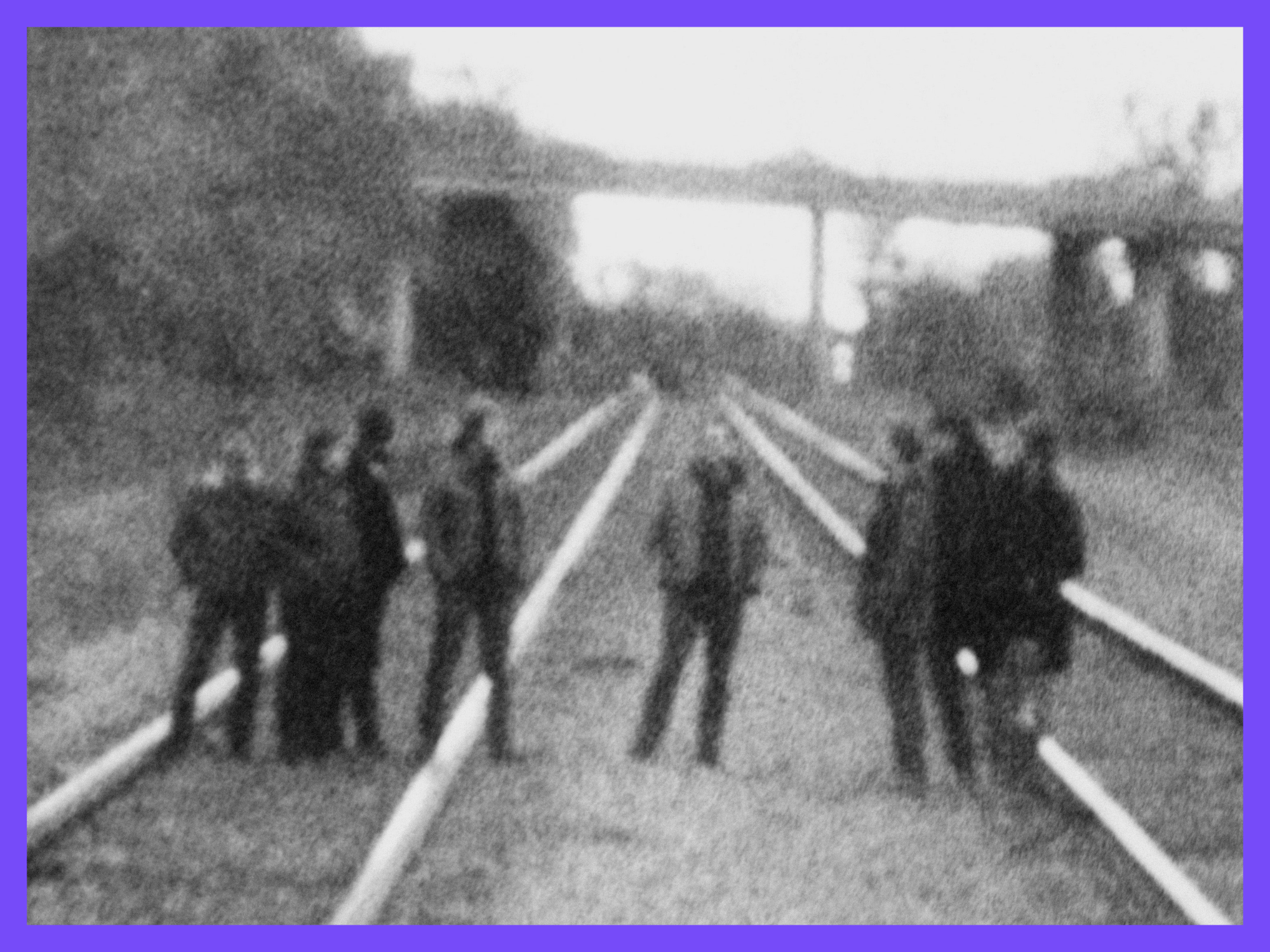
Errant being.
393 stories
·
0 followers

Godspeed You! Black Emperor Tell Their Story for the First Time Ever

1 Share
Godspeed You! Black Emperor Tell Their Story for the First Time Ever

Efrim Manuel Menuck has eight finger tattoos. 

He laughs at the ones on his left hand—uneven little lightning bolts, the ink faded so thoroughly they look almost silver now. Menuck, 56, has been a professional musician for three decades, founding Godspeed You! Black Emperor as his binge-drinking exercise in home recording in 1993 and starting the radical chamber ensemble A Silver Mount Zion Memorial Orchestra six years later. Still, he doesn’t consider himself an especially good musician or dazzling guitarist. “I like the idea of having lightning fingers,” Menuck says, smiling on a sunny day in his little Montreal backyard and waving his hands. 

He laughs, too, when I tell him about what I’ve read online regarding the notes on his right hand: F, G#, F, B♭. Are they truly notes to self, to remember how to tune his guitar? “No!” he says, his voice breaking with delight. “What am I, Steve-O from Jackass? It’s ‘A Love Supreme.’” He starts singing the standard, tapping each finger to correspond to the melody. 

When Godspeed first emerged beyond Canada in the late 1990s, they arrived in a cloak of intentional mystery. Their debut, F♯ A♯ ∞, had several blurry covers, included a penny flattened by a train, and, aside from the disembodied voice that opened the record with a monologue about flailing governments amid assorted samples, featured no vocals. They gave very few interviews, even less personal answers. They avoided publicity stills, too; when NME put Godspeed on the cover of a July 1999 issue, pronouncing them as “the last great band of the century,” it was the only time that venerable hype-machine has foregone a band photo up front. “We don’t trust what other people choose to do with our words, ideas, and feelings,” Godspeed collectively wrote in response to NME’s questions. “Our few encounters with rock journalists have left us feeling regretful.”

For 30 years, then, myth has filled a vacuum of fact: The members of Godspeed were radicals who squatted in warehouse spaces amid the post-industrial ruins of Montreal. They were the hub of a sprawling arts collective and a Dadaist orchestra that barely cared about sound. They were possibly terrorists, debatably assholes, absolutely anarchists. Maybe they lived in a polycule, too? And, of course, at least one of them had finger tattoos to help them remember guitar tunings. 

“They rolled up in an old short bus that was painted blue, very mysterious and serious about what they were doing,” remembers Low’s Alan Sparhawk, who took Godspeed on one of their earliest American tours. “That was a time when, promoting a band, everybody had a one-sheet: What’s the short story? They’re Montreal anarchists, political. That would stick.”
sponsored by
Godspeed You! Black Emperor Tell Their Story for the First Time Ever

Corus is a social app for sharing and discovering music. Post your favorite songs and match with people that share your taste. Follow @hearingthings on the app too!

GET CORUS

Late last June, I happened to be in my North Carolina hometown when Godspeed was making up a nearby show they’d canceled seven months earlier. Their bus had broken down on the way to the venue, so the line snaked for half a mile down a rural road as folks waited on doors to open. As I walked along the queue, I was stunned by how many people there were in their teens or early 20s, how they hadn’t even been alive during Godspeed’s mythmaking heyday. 

I remembered what it was like to encounter Godspeed for the first time—a college freshman in September 2001, stifled then by a rush of American jingoism and calls to arms that hang around like fetid air even now. They extended the wordless affirmation that it was OK to disagree, to reject the prospect of endless war. It changed my life. The guitarist Tashi Dorji tells me that seeing Godspeed soon after he moved from Bhutan to North Carolina helped him feel like he’d found a “world of radical, traveling anarchists and music makers.” Watching kids be swallowed by Godspeed’s din last year, in the early months of the second Trump administration, I sensed it still had that power. 

What’s more, that night I heard Godspeed had been forced to cancel its November 2024 show because Menuck had allegedly suffered a stroke on tour, a few months after turning 54. I started to think about what a shame it would be for something to happen to Menuck in general but especially when he was still so shrouded in relative secrecy, when the scattershot interviews he allowed still felt so elliptical. Menuck and I had spoken briefly in 2022, when he released the 1993 solo recordings he’d made under the Godspeed name before it was even a band, as a fundraiser for medical care in Gaza. “In actual conversation with people, I am open,” he told me that February. “Actually, I feel like I’m kind of an open book.” 

A few weeks after that 2025 show, then, I sent him an email to test that statement: If he was such an open book, could I come to Canada and interview him at length, something no one had ever done? Not because Godspeed has a new record out, which they don’t, but simply because I thought his story was one that needed to be written. (Menuck is finishing a few different solo and side-project albums right now, but his only current hope for Godspeed is to cut a live record in Puerto Rico soon.) After months of back and forth, he agreed. So much of the writing about Godspeed has leaned into the power of their enigma, he said; he finally wanted to tell his story. “But I need a long runway to feel like I’m getting anything across that makes any sense,” he warned. 

In late April, I arrived in Montreal to spend two days with Menuck. He drove me around town, showing me the band’s former loft space, Hotel2Tango, and the studio of the same name in the building he and a few others now co-own with Godspeed’s record label since the beginning, Constellation. But mostly we sat at a faded wooden table in his backyard in Park Extension, the immigrant-heavy Montreal neighborhood he has called home for 16 years, since being priced out of most everywhere else. He is hoping to buy the row house soon, the first place he’s ever owned. “The gentrification that’s happened all over the city? It’s never hit here because of fucking racism,” he says, chuckling and rolling another cigarette. “People will come here to eat Indian food, and then they go back. They can’t deal with the fact the neighborhood smells like Indian food all the time.” 

Menuck was right about being an open book. A father of two then a couple of months away from celebrating his seventh wedding anniversary, he described a miserable childhood in which he was raised by an unprepared single father and stuck in notorious Zionist schools in Toronto. He told me about leaving home as a teenager, how he’d lived on the precarious margins of society and barely made it out alive. We talked about panic disorders and acid trips, the limits of protest and the last gasps of capitalism, the Grateful Dead and the Boston Red Sox (whom he apologized for liking). What’s more, Menuck detailed the inner workings of one of rock’s last great enigmatic acts: their simple reasons for quitting streaming services, their logic for reforming in 2010, their struggles as they moved outside of their comfort zone, as when they opened for Nine Inch Nails in arenas. (I should say now that I sent everyone else in Godspeed a letter, asking them to talk about Menuck; no one responded.)

By the time Menuck and I had spent 10 hours talking, I understood why Godspeed still mattered so much, why the kids on that hot summer night in North Carolina got as much out of the absorbing melodic din as I did a quarter-century earlier: An eight-person collective of Montreal misfits that still debates every major decision and, aside from a booking agent and an accountant, remains largely outside of the music industry’s structures and strictures, they are the kind of band that should no longer exist, that the demands of the market should have eliminated long ago. Before they even play a note, Godspeed’s mere existence in 2026 is itself an act of resistance. Menuck’s is, too.

“The work has been like filling buckets on a sinking ship, dumping it back into the ocean. There’s no land in sight, but that doesn’t mean things are hopeless,” he tells me, pushing his hands through his peppery gray beard. “Godspeed has to keep going until we die—not in a vainglorious way, but because it would just suck if we gave up. We’re supposed to be here in our corner, doing our weird thing. Doing the spectacle has its own inherent value.”

Free trial offer
Godspeed You! Black Emperor Tell Their Story for the First Time Ever

Get access to everything we do at Hearing Things—including weekly album and song recommendations along with our ever-growing archive of interviews and reports—with a free 30-day trial!

FREE ALL-ACCESS TRIAL

Read the whole story
jchalifour
13 hours ago
reply
Montréal
Share this story
Delete

Quebec municipalities and environmentalists say province's water reserves are at risk

1 Share
montreal skyline

A group of environmental organizations and municipalities are worried that Quebec's groundwater reserves are dwindling as the province consumes more water than is being replenished.

Read the whole story
jchalifour
156 days ago
reply
Montréal
Share this story
Delete

Why this butterfly could soon become Quebec’s 1st insect emblem

1 Share
A butterfly sits atop a person's finger, with an image of a quebec flag in the background

MNAs at Quebec’s National Assembly have voted in favour of Bill 496, which recognizes the white admiral as one of the province’s symbols. Native to Quebec, the butterfly could become its first insect emblem following a decades-long campaign.

Read the whole story
jchalifour
254 days ago
reply
Montréal
Share this story
Delete

Read Mark Carney's full speech on middle powers navigating a rapidly changing world

1 Share
A man speaks into a microphone at a podium.

Read the full text of Prime Minister Mark Carney's speech about a shakeup of the global order and role of middle powers at the World Economic Forum in Davos, Switzerland.

Read the whole story
jchalifour
295 days ago
reply
Montréal
Share this story
Delete

Cyclists protest Montreal borough’s decision to close section of bike path this winter

1 Share
Protesters on Lajoie Ave. bike path in Outremont borough.

A portion of the path on Lajoie Avenue in the Outremont borough, which was open last winter, will be closed off this season. Despite the move coming from the borough, it’s raising concerns about whether there will be similar closures under the City of Montreal's new administration.

Read the whole story
jchalifour
344 days ago
reply
Montréal
Share this story
Delete

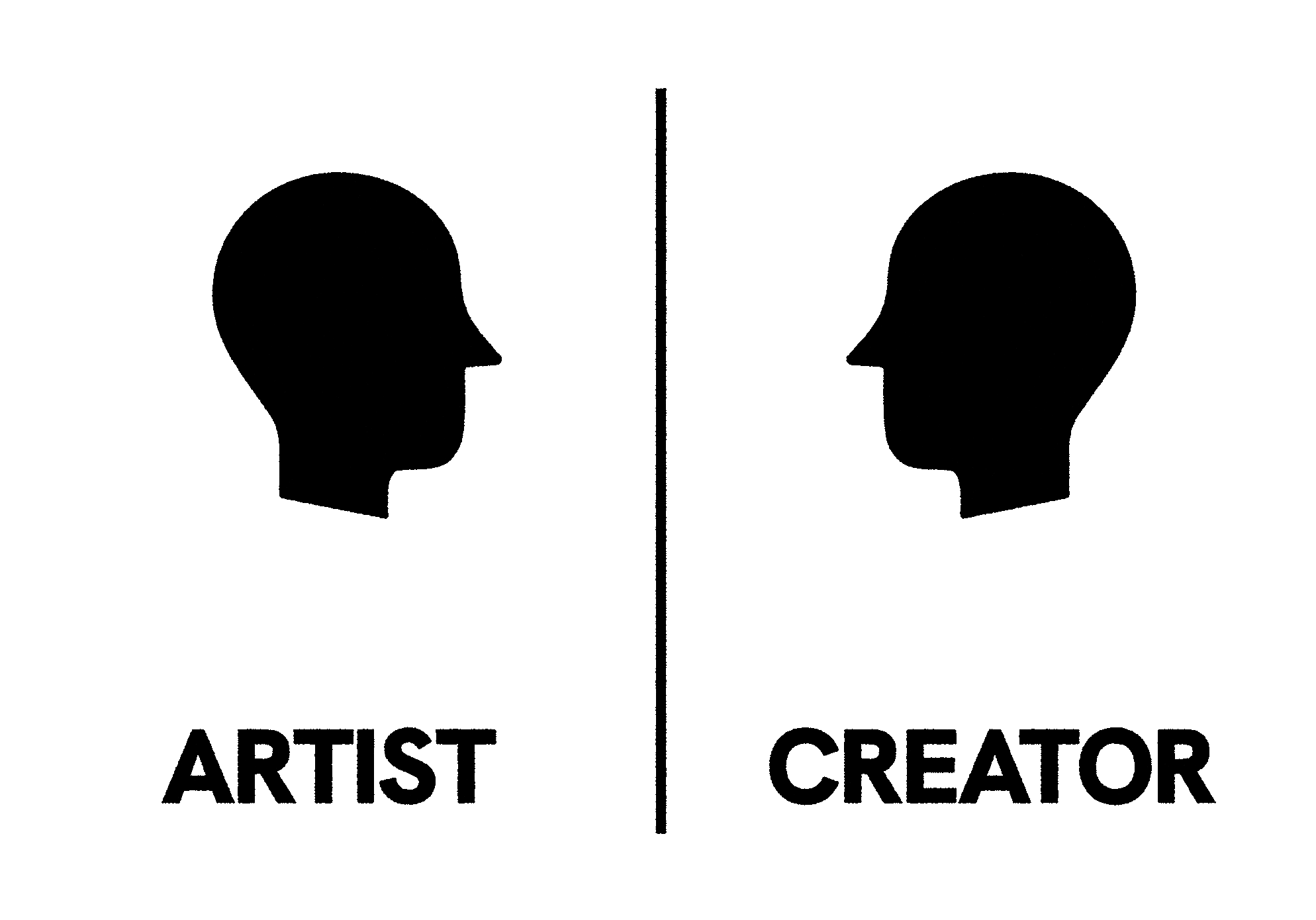
What's the difference between an artist and a creator?

1 Share
What's the difference between an artist and a creator?

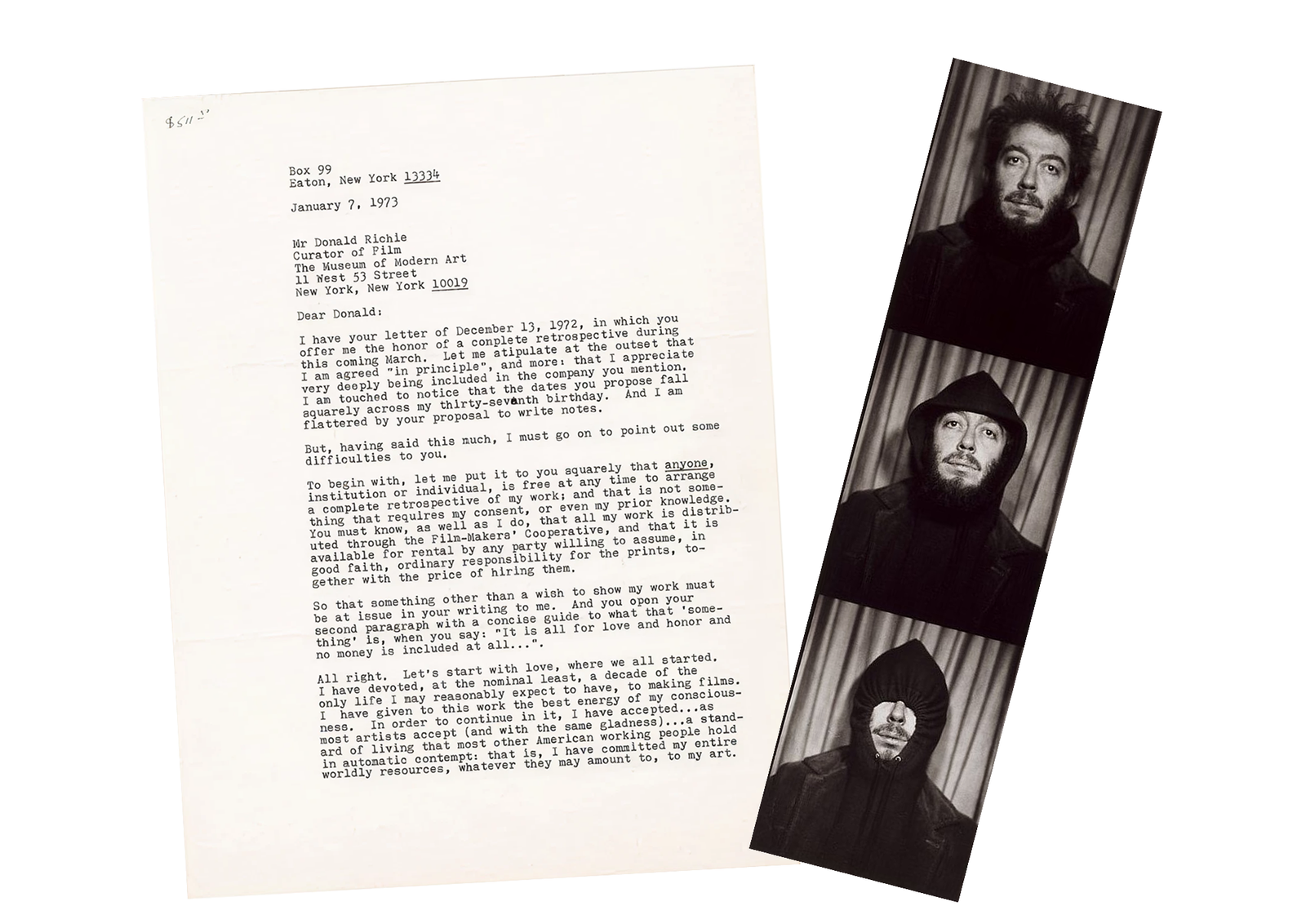
In 1973, experimental filmmaker Hollis Frampton wrote a letter to MoMA that captures a paradox that still defines creative work today. 

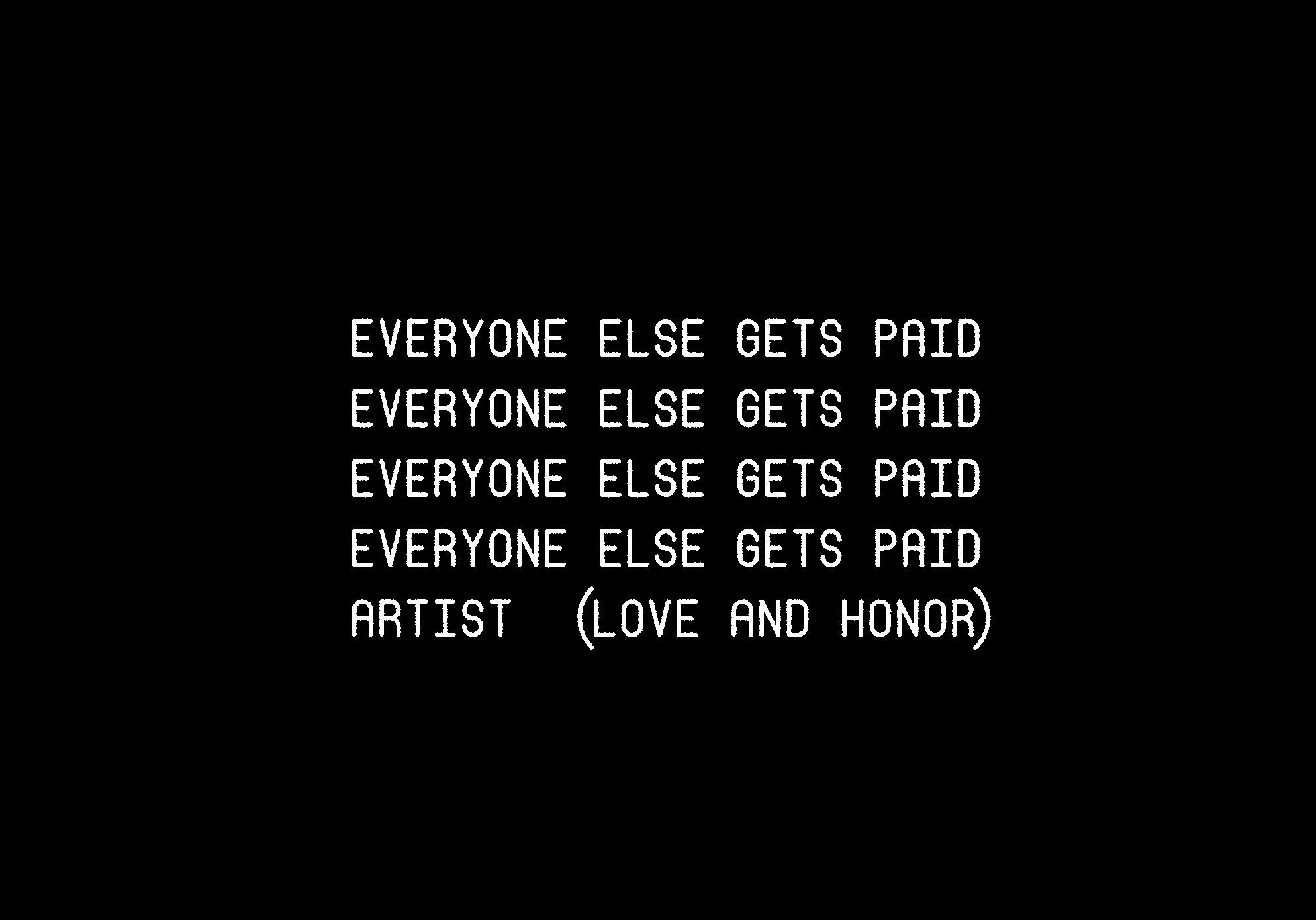
The Museum of Modern Art had offered the filmmaker a retrospective of his work. However he was also told there would be "no money included at all" and it would be "all for love and honor” instead.

Frampton was furious, and responded with a lengthy letter listing all the people who would be paid for the show but not him: projectionists, security guards, administrators, film developers, on and on. Why was everyone but the artist being compensated?

What's the difference between an artist and a creator?

"I, in my singular person, by making this work, have already generated wealth for scores of people," Frampton wrote. "Ask yourself whether my lab would print my work for 'love and honor.' They would explain to me, ever so gently, that human beings expect compensation for their work. Yet while all these others are to be paid for their part in a show that could not have taken place without me, I, the artist, am not to be paid."

Frampton’s plea is both specific to his circumstances and universal for artists everywhere. (There’s no record of the curator’s response, but the show did happen.)

But this isn’t always how things work out, as we find when we fast forward three decades to a very different moment in the history of creative compensation.

It’s 2004. An artist named David Choe gets asked to paint a mural in the office of a young startup looking to decorate their walls in Northern California. Because it’s Silicon Valley and they specifically wanted Choe, he gets offered a choice of compensation: $60,000 in cash or the equivalent in company stock.

Choe chose the stock.

The startup was Facebook. 

When the company went public a few years later, those shares were worth more than $200 million. Making it almost certainly the best-paying mural gig in history.

What's the difference between an artist and a creator?

Divergent paths

These two stories represent extreme poles of how we do and don't value creative work. Creative work done for artistic purposes is thought to exist for reasons above money. "Love and honor” is a convenient excuse to not compensate for it, “exposure” too. Creative work for commercial purposes, on the other hand, can be handsomely rewarded. However you’re doing a job for somebody else.

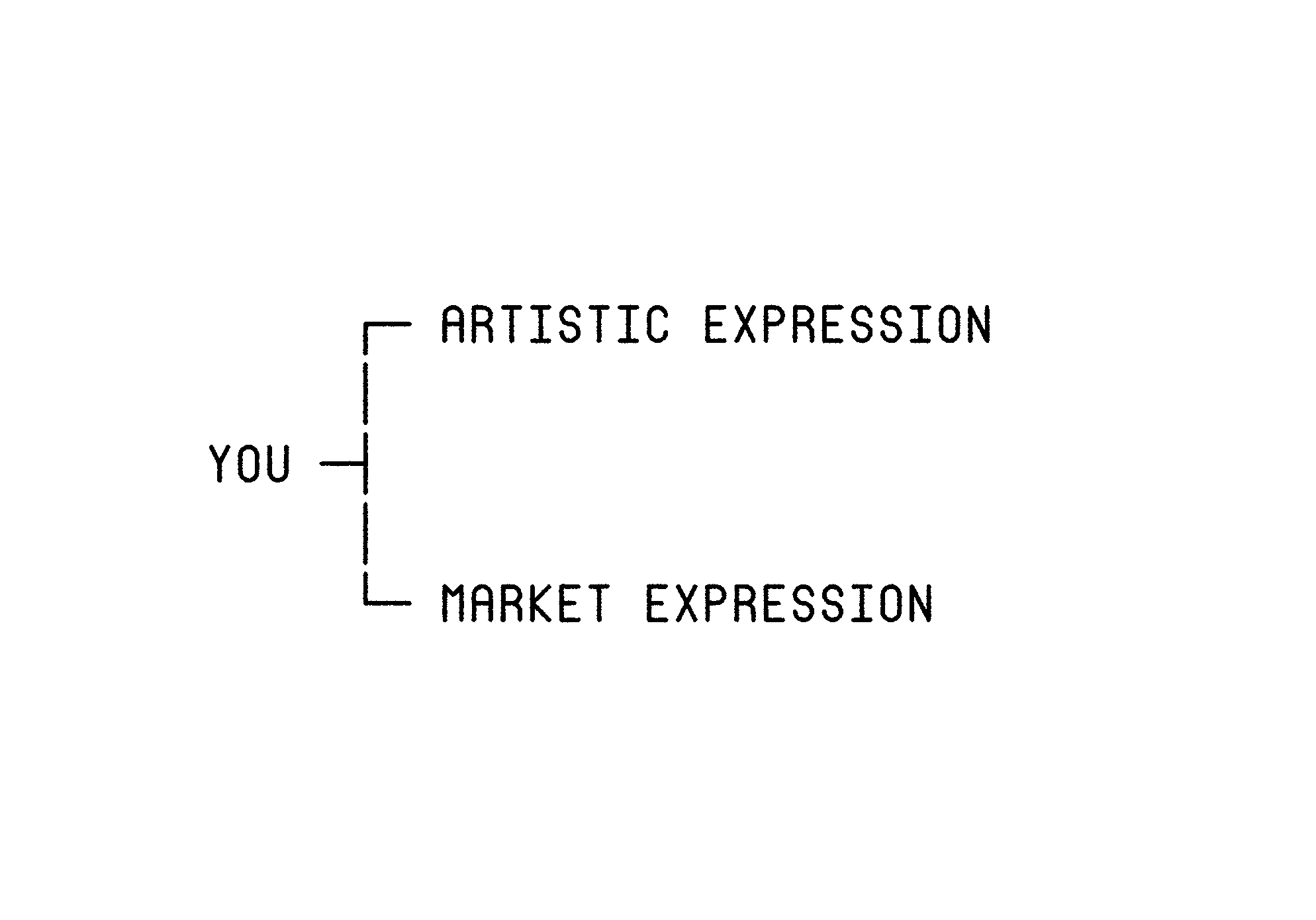
The people who make the first kind of work are historically called “fine artists.” The people who make the second kind of work are called “commercial artists.” These two roles defined the creative landscape for centuries. There’s work you do for yourself (capital-A Art) and there’s work you do for others (sometimes Art, but also decoration, ego-fluffing, and market-driven motivations). Most creative people straddle a hybrid of both: commercial art for their livelihoods, fine art for their souls.

(This post implicitly uses visual artists as the representative category of what an “artist” is, but the logic and term equally apply to other types: writers, filmmakers, musicians, performing artists, so on.)

What's the difference between an artist and a creator?

In recent decades a similar but distinct creative role has emerged: the creator. People who make a living from subscriptions, crowdfunding, selling merch, and other forms of direct exchange unlocked by the web.

Like artists, creators have a lot of freedom in what they do. They’re even more free in some ways, as they aren’t confined to the canon of what they’re “supposed to do.” All tools of the market are at their disposal: from products to livestreams to memecoins to ghost kitchens to limited edition drops. Unlike artists, they don't have to navigate the academy system or art world politics to do it.

Creators don’t answer to a boss, but they do answer to an audience. For most this is a smaller audience than they hope. For a few this means fame and attention beyond imagination whose pressure can create a performative cycle that can eventually lead to burnout and debilitating narcissism.

Also unlike artists, creators are explicitly commercial in what they do. They want you to smash that like and subscribe button. They launch courses and new products to further monetize themselves. They see their work as inherently commercial, even industrial. The opposite is true for most artists.

Artists, commercial artists, and creators

If we think about the functions each of these roles perform at a high level, we get a sense of the differences between them.

What's the difference between an artist and a creator?

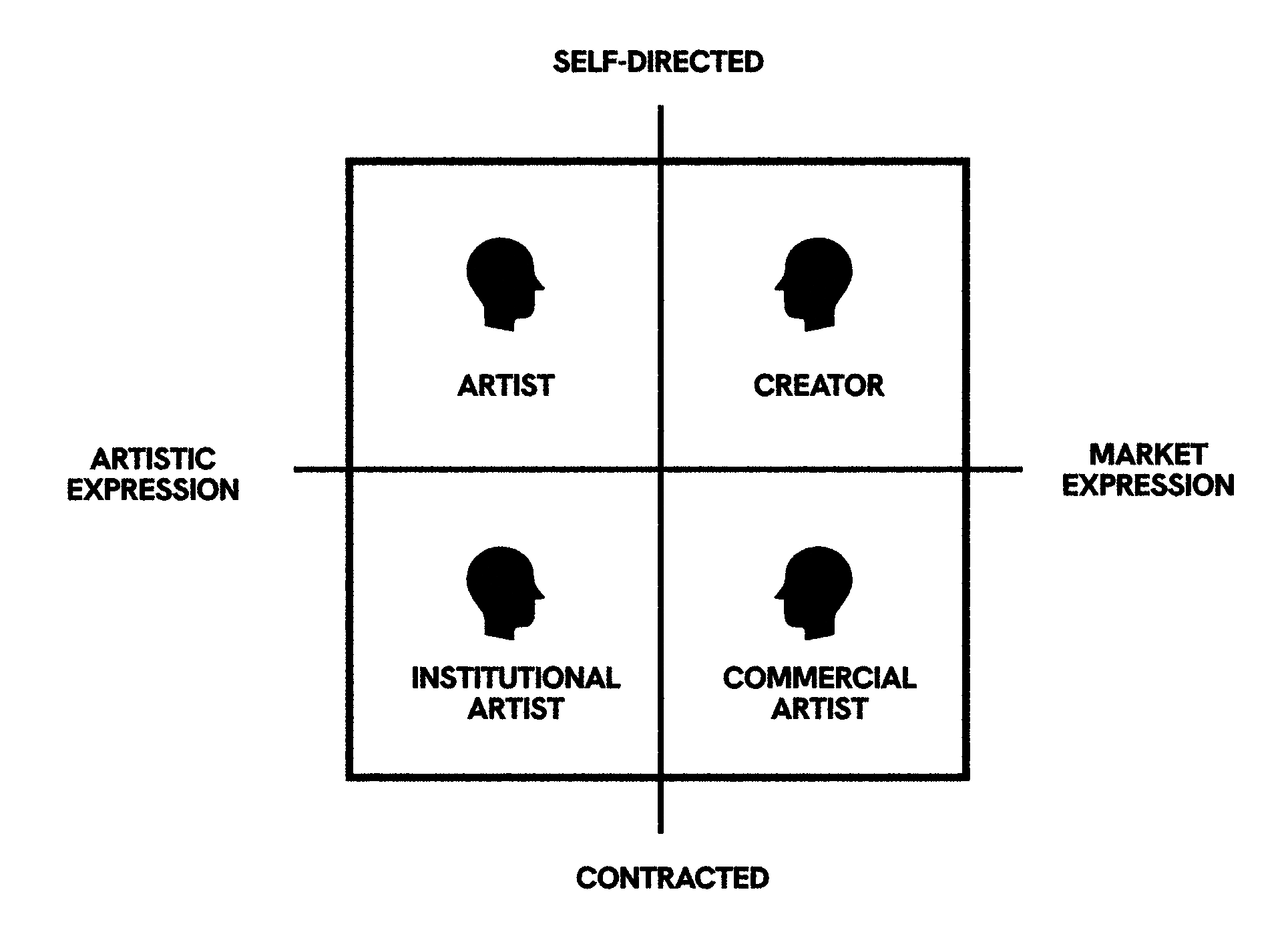
An artist is a self-directed artistic expressor. They work for themselves and express what they want. There’s no one beyond their anxiety looking over their shoulder telling them what to do.

A creator is a self-directed market expressor. Everything they do has a commercial aim at its core, but they answer to themselves and their audience. Rather than a traditional boss, they have an algorithmic one that implicitly and explicitly shapes their output. 

A commercial artist, or "a creative," is a contracted market expressor. Everyone who works at an ad agency or as an in-house designer fits into this bucket. This group is much better paid than anyone else because they fulfill a market-oriented purpose. Today this role is often called a “creative” — a dehumanizing phrase with roots in the advertising industry.

An institutional artist is a form of contracted artistic expression. Think of an artist being asked to produce a Biennale commission or a piece for a museum. They are being contracted for their voice in a defined way. You have to have “made it" to be part of this quadrant.

These segments also show us how and by whom each gets paid:

Role: Artist
Who pays:
Patrons, foundations, collectors
How: Grants, residencies, commissions, sales of work

Role: Creator
Who pays:
Audiences, platforms, sponsors
How: Memberships, merch sales, rev shares, sponsorships

Role: Institutional artist
Who pays:
Museums, public arts, universities, nonprofits
How: Commissions, grants, honoraria, stipends, exhibition fees

Role: Commercial artist or Creative
Who pays:
Employers, agencies, brand clients
How: Salaries, day rates, project fees, retainers

The artist is the least compensated because there’s no outside entity contracting them to produce their work. Commercial artists and creatives are the highest paid because there are. Creator incomes range across a huge curve defined by the size of the internet. Institutional artist funds are the hardest and often stingiest to get.

In terms of artist compensation, the data supports this. Art critic Ben Davis reports in his excellent book 9.5 Theses On Art and Class that “artists earn less than workers in their reference occupational category (professional, technical and kindred workers), whose members have comparable human capital characteristics (education, training and age).” 

Artists get paid less than people like them. Now we see why.

What's the difference between an artist and a creator?

How big are these groups?

How many people are in each quadrant?

Ben Davis writes that of the 2.1 million self-declared artists in the US Census in 2010, “fewer than one in ten were ‘fine artists.’ About 10% of these so-called creative laborers worked in architecture and about 17% in the performing arts. By far the largest portion of creative laborers — close to 40% — were classified as ‘designers’ of various kinds.”

This suggests the number of artists is quite small, at least when it comes to full-on careers. But more recent data suggests a more nuanced picture. In a 2023 survey, 48% of Americans reported having an active creative practice — art, music, or writing. This makes creative expression as popular as watching the NFL — long considered the most American thing there is. These numbers are likely to grow. Among Gen Alpha, 30% report that their goal in life is to be a creator. 

These numbers also mean that most people really do it for “love and honor” (sorry Hollis Frampton) rather than money. Some intentionally because they’re making for themselves. Others because they don't yet have an audience that will reward them, and likely never will.

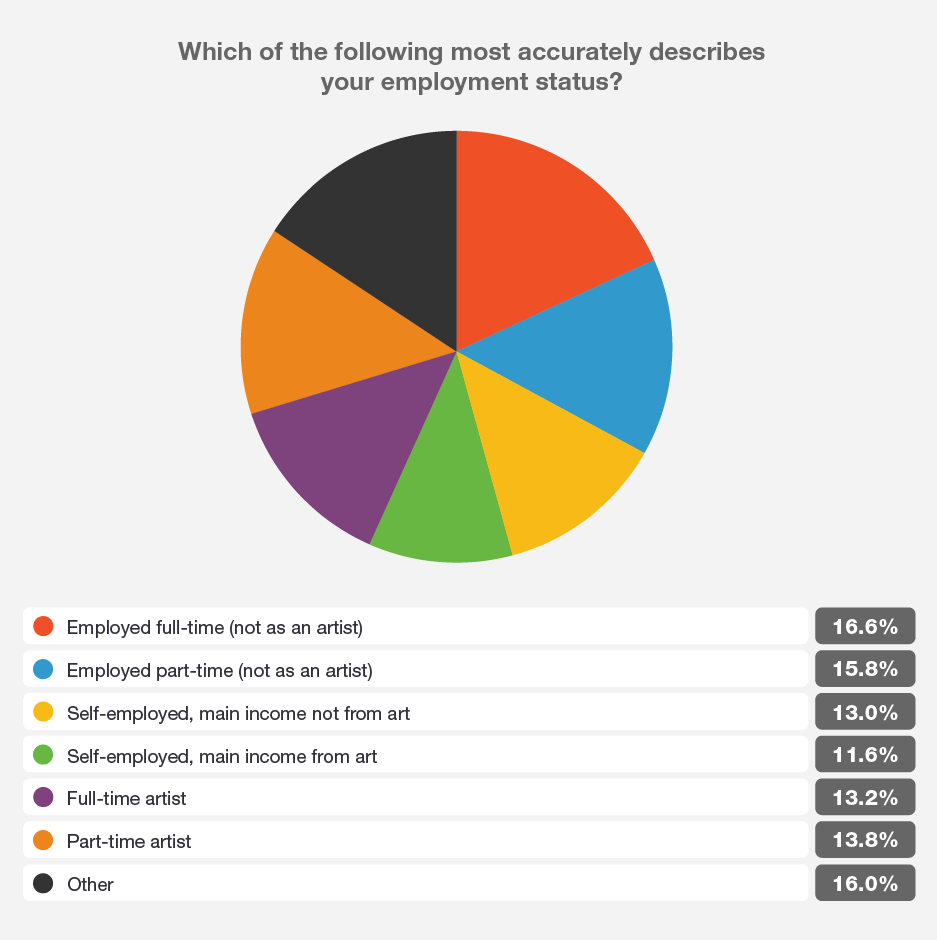
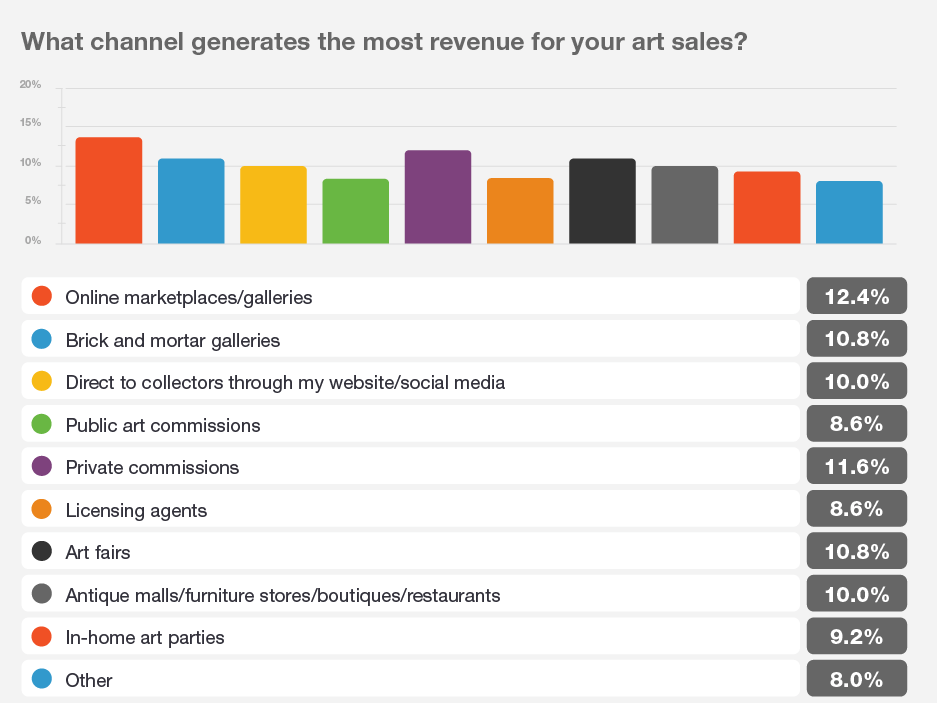
If we dig deeper into just the segment of artists who already generate income from their work, we get a better sense of the dynamics. A 2022 survey by the Saatchi gallery of 500 artists who make money from their art lets us do exactly that. Their report found that 13% of artists were able to earn a full-time living from their work, while 16% were employed full-time in non-art jobs.

What's the difference between an artist and a creator?

Most of the artists have to piece together an income from various sources. A minority do not. The same survey also asked artists their sources of funding, which reveals the creative funding complex the four quadrants listed.

What's the difference between an artist and a creator?

The need for new models

Contrasting Frampton's MoMA letter with Choe's Facebook windfall and today's creator economy reveals persistent patterns in how creative work is valued. And how it isn’t. 

Creative work by inspiration is seen as unpaid and without value. Creative work for commercial purposes is worth compensation if it meets the brief. Institutions remain the primary mediators of payment, whether they're museums, corporations, or technology platforms. Virtually all who participate move through them in one form or another.

What, if anything, about this structure can and should change? We feel drawn to two ideas that feel deeply intertwined:

1) Increasing creative agency 
2) Increasing economic control

By increasing creative agency, we mean freedom for creative people to move between quadrants. Artist, Creator, Institutional Artist, and Commercial Artist are all potentially attractive and consequential roles for a creative person to embody, depending on the context. We should continue to work towards a creative universe where these roles are fluid and open to all. We should also grow the respect for the artist and creator in these contexts. As they move into market-based and contracted forms of expression, we wish to see a greater empowerment of the creative voices making the work.

By increasing economic control, we mean more direct access to funding, more sophisticated ways of using those funds, and a greater ability for the artist to determine and participate in the economic value of their work. Right now artists find themselves dependent on larger entities that translate non-commercial expression into commercial value (galleries, publishers, platforms, labels). These systems are critical, but they also have a tendency to keep artists dependent, financially precarious, and have historically imposed exploitative terms on the creators of the work. This must change.

What's the difference between an artist and a creator?

Moving forward, not backward

Future creator-artists and artist-creators need better control of their destinies. They should be able to protect their visions, generate reliable income, and financially participate in the full outcomes of their work.

Right now this isn't easy, but this is what the Artist Corporation is designed to change. The A-Corp aims to introduce a new kind of corporate entity that can receive a wide variety of revenue sources (all areas of the quadrant); enable resource pooling (like group health insurance); and make the creation of collective ownership and shares for creative work possible for the first time. 

While we feel a strong moral and romantic pull towards the solitary artist as the outsider truth-teller, we also need a structure that better organizes, values, and sustains creative work in ways that reflect all the persistent nuances of how it operates. Some things are commercial. Other things are not. Sometimes people engage in explicitly self-oriented creative projects for which no compensation makes sense. Other times it absolutely depends on it. Regardless, the people behind the work need to eat and support themselves.

These questions have plagued creative people since the beginning of time. We're just the latest in a long line of people facing this. But what if this marks the end of one era and the start of another? What if a world where it can be for love and honor and there can still be money at the end — not in every case, but in more cases than before — is actually possible?

This groupcore future is what we are actively working to manifest.

What's the difference between an artist and a creator?
Read the whole story
jchalifour
345 days ago
reply
Montréal
Share this story
Delete
Next Page of Stories